Artificial Intelligence Masterclass

Learn how machines learn, one unit per week, with every method worked through by hand and the research that produced it.

  • Certificate
  • Online
  • Join a community of 5000+
An operator at the Mark I Perceptron, with a large letter C on a card in front of its camera. Black and white, cropped.
Neural networksThe Mark I Perceptron, 1958
Ink drawing by Santiago Ramón y Cajal of the neurons of the retina, long cells stacked in horizontal layers.
NeuroscienceCajal's drawing of the retina
A yellow industrial robot arm moving sample plates in an automated laboratory.
RoboticsA robot arm in a laboratory
Reinforcement learningQ-learning, live in this page
Black and white Go stones on a wooden board in warm light.
GamesGo, the game AlphaGo learned
NASA's Perseverance rover on the surface of Mars, photographed by its own arm camera. Cropped.
Autonomous navigationPerseverance on Mars, 2021

Twelve weeks with learning machines

The AI Masterclass takes you through artificial intelligence one unit at a time. You enrol, and from then on a new unit reaches you every week. Each unit is a chapter written for this program, with worked examples you can follow with pencil and paper, short pieces of Python, and the published research of scientists who are active today.

A quiz completes every unit and opens the next. At the end you sit a final exam and receive a certificate with a public verification page.

Cognitive science and neuroscience
Ink drawing by Santiago Ramón y Cajal of the neurons of the retina, long cells stacked in horizontal layers. input hidden output

Left: Santiago Ramón y Cajal's drawing of neurons of the retina, separate cells arranged in layers. He shared the 1906 Nobel Prize in Physiology or Medicine with Camillo Golgi. Right: an artificial network with the same layered plan, drawn for this page; line widths stand for weights chosen for illustration. Santiago Ramón y Cajal, Wellcome Collection, CC BY 4.0, source

  • Structured. A fixed sequence of units that begins with vectors and probability and reaches the transformer, the architecture behind today's language models.
  • Demanding and fair. Loss functions, gradients, and backpropagation are derived in small steps, and each step can be checked by hand.
  • Recognized. A certificate and a transcript, both with a verification ID that anyone can check online.

Who the masterclass is for

An operator adjusts the Mark I Perceptron; a card with a large letter C stands in front of the machine's camera. Black and white.
Neural networks The Mark I Perceptron saw through 400 photocells arranged in a 20 by 20 grid and stored its weights in potentiometers turned by electric motors. Here it is shown a letter C. Unit 6 begins with it. National Museum of the U.S. Navy, public domain, source

High School Students

You use AI every day and want to know how it works, and you want a head start before university. The masterclass also prepares you for competitions such as the International Olympiad in Artificial Intelligence (IOAI) and its national selection rounds, and gives you the theory for your first Kaggle competition.

  • School mathematics is enough
  • Certificate for applications
  • A head start in machine learning

University Students

A supplement to your degree in computer science, mathematics, engineering, or any subject that now uses machine learning. Use it to prepare for lectures in machine learning, a thesis, or a first research project.

  • Derivations and worked examples
  • Current research papers
  • A base for a first project

Lifelong Learners

You work with AI tools, or you read about them in the news and want to know what is underneath. The masterclass explains the field step by step, together with the seventy years of ideas that led to it.

  • No deadlines, pause any time
  • Unit 1 refreshes the mathematics
  • Read on screen or as PDF

How it works

  1. Enrol

    Create your account with your email address, choose your masterclass, and pay the Tuition Fee. Your program starts at once.

  2. Receive your unit

    Unit 1 arrives immediately, every further unit on a Monday: as a web page and as a PDF to keep.

  3. Study

    Work through the text, the worked examples, and the derivations, and try the tool of the week. A day later we send further reading with current research papers.

  4. Take a quiz for every unit

    Each unit has its own quiz: ten questions, open book, no time limit. You submit it before the next unit is sent to you.

  5. Sit the final exam

    50 questions across all units of your masterclass in 60 minutes, open book. Pass with 70%, with up to 3 attempts.

  6. Earn your certificate

    Certificate and transcript as PDF, each with a verification ID and a personal link you can share.

Reinforcement learning, Unit 12
Episode 0

Q-learning in an 8 by 6 gridworld, computed in this page. The agent starts knowing nothing; an episode ends at +1, at −1, or after 200 steps. Each cell is shaded by the value the agent has learned for it, the largest of its four action values, with discount γ = 0.9. After 200 episodes the arrows show its policy.

A week in the program

Monday
The unit arrives by email, as a web page and as a PDF.
A day later
Further reading, including current research papers that are free to read.
During the week
Study the unit, try the tool of the week if you like, and take the open-book quiz of ten questions.
Next unit
Sent once your quiz is in. You can ask for it early, at the earliest 24 hours after the previous unit.

Most participants spend three to four hours a week.

The final exam

Questions
50, multiple choice, across all units of your masterclass, drawn individually for each participant
Time
60 minutes, open book
Pass mark
70% correct answers
Attempts
Up to 3, each after 3 days and with new questions

The curriculum

Each unit is a weekly chapter with its own quiz. The Foundation masterclass covers Units 1 to 8, Advanced adds Units 9 to 12, and Advanced + Large Language Models adds Units 13 to 16.

Foundations of AI Units 1 to 8

How a program searches for a plan, how it weighs evidence with probability, how it learns a rule from examples, and how a neural network trains itself by gradient descent.

  1. 1The AI Researcher's Toolkit

    Every learning machine, from the perceptron of 1958 to a language model, holds its knowledge as numbers, measures how wrong it is, and changes the numbers to become less wrong. This unit teaches the mathematics behind those three ingredients: data as vectors and the dot product, probability and Bayes' rule, logarithms, the derivative and the gradient, and what it means for an algorithm to be fast, with a closing page on how numbers reach a computer.

    More about Unit 1

  2. 2Search and Planning

    A route planner, a puzzle solver, and a chess computer all describe their task as states, actions, and a goal, and then explore a tree of possibilities. This unit shows how breadth-first, uniform cost, and A* search organize that exploration, why the work grows as b to the power d, how an admissible heuristic tames it, and how minimax with alpha-beta pruning chooses a move. It ends with the numbers that explain why chess fell to search in 1997 and Go resisted until 2016.

    More about Unit 2

  3. 3Reasoning under Uncertainty

    A machine that acts in the world must decide with evidence that is sometimes wrong. This unit shows how a joint probability distribution answers every question and why it is far too large to store, how a Bayesian network shrinks it with conditional independence, and how inference by enumeration and Bayes' theorem turn an observed effect into the probability of its cause. The naive Bayes spam filter and a Markov chain of the weather are worked through with every number, and a hidden Markov model infers rain from umbrellas.

    More about Unit 3

  4. 4Learning from Data

    Every learning method needs a model with parameters, a loss that measures how wrong it is, and a procedure that lowers the loss. This unit builds all three on a straight line through six house prices, derives least squares, takes the first gradient descent steps on a real loss, and then shows with polynomials why a model that fits its training data perfectly can predict badly on new data, how cross-validation and a ridge penalty control that, and why the largest modern models escape the classical picture.

    More about Unit 4

  5. 5Classifiers and Decision Trees

    Three classifiers built by hand on real data: logistic regression with the cross-entropy loss derived from maximum likelihood, k-nearest neighbours, and decision trees grown with entropy and information gain, with random forests as the step beyond one tree. The unit ends with the measures that tell you how good a classifier really is, the confusion matrix, precision and recall, and the ROC curve, and with the debate about readable models in high-stakes decisions.

    More about Unit 5

  6. 6Neural Networks and Backpropagation

    A single neuron can draw one straight line through its data, and the XOR function shows why that is not enough. This unit puts neurons in layers, computes XOR with three of them, and derives backpropagation, the algorithm that finds the gradient of every weight in one backward sweep, on a network small enough to train by hand. It ends with the softmax output for many categories, a two-layer network that reads handwritten digits with 98 per cent accuracy, and what the universal approximation theorem does and does not promise.

    More about Unit 6

  7. 7Training Deep Networks

    Unit 6 gave the gradient; this unit gives the practice that turns it into a trained network. It explains why the gradient is estimated on a minibatch, how to read a learning rate off a loss curve, what momentum and Adam add and why Adam's learning rate is so small, how the gradient vanishes through twenty sigmoid layers and what the ReLU function, batch normalization, and residual connections did about it, how weight decay, dropout, early stopping, and augmentation keep a network honest, and what a training run costs in FLOP, GPU-hours, and dollars.

    More about Unit 7

  8. 8The Big Questions of Artificial Intelligence

    The closing unit of the Foundation asks what the methods of the first seven units add up to. It reads Turing's 1950 paper and scores his imitation game with real numbers, tells the history of the two traditions and the two winters as a story of money, hardware, and data, and shows why 2012 was different, with the AlexNet numbers and the compute that has grown by eight orders of magnitude since. It presents the Chinese room argument and its replies fairly, examines what AlphaFold and the antibiotic halicin did and did not do, states the four questions that divide the field today without a verdict, and ends with a map of the eight units and the one equation under them.

    More about Unit 8

Computer vision, Unit 9
Filter at row 1, column 1

A convolution computed in this page. The input is a letter C on a 20 by 20 grid, the size of the Mark I Perceptron's eye. At each position the filter multiplies the nine pixels under it by its nine weights and adds them up; the feature map shows the size of each sum.

Deep Learning Units 9 to 12

How convolutional networks see, how words become vectors, why attention made the transformer possible, and how an agent learns by trial and reward, as AlphaGo did.

  1. 9Convolutional Networks and Computer Vision

    A fully connected layer on a photograph would need 150 million weights and would have to learn every object once for every position. This unit replaces it with a small kernel that slides over the image, computes a convolution by hand, shows how the kernels are learned by backpropagation, and follows the design from LeNet-5 in 1998 to AlexNet in 2012 and the residual networks after it. It ends with transfer learning, which is how a few hundred medical images become a working classifier, and with adversarial examples, which show that the network does not see as we do.

    More about Unit 9

  2. 10Embeddings and Sequence Models

    A word is a symbol and a sentence has no fixed length, so neither fits the networks of the earlier units. This unit turns words into vectors that carry meaning, learned from nothing except which words appear near which, and builds the recurrent networks that read a sentence one word at a time. It shows by hand why such a network forgets after a few steps, how the gates of the LSTM fix that, how an encoder and a decoder translate, and what the perplexity of a language model measures.

    More about Unit 10

  3. 11Attention and Transformers

    In 2014 a decoder was first allowed to look back at every word of the sentence it was translating, with weights it had learned, and in 2017 eight researchers kept only this looking back and dropped the recurrence. This unit works one step of scaled dot-product attention by hand on three tokens, shows why the scores are divided by the square root of the key dimension, adds heads and positional encodings, and assembles the transformer block. It counts the 65 million parameters of the original model, explains why the architecture trains so fast and why its cost grows with the square of the text length, and ends with BERT, GPT, and the vision transformer as three uses of one block.

    More about Unit 11

  4. 12Reinforcement Learning

    A learner that is told only how well it did, and only later, needs its own mathematics. This unit builds it from the agent-environment loop and the Markov decision process to the Bellman equations, runs value iteration and Q-learning by hand on a 4 by 4 gridworld, and shows what the deep Q-network changed so that the same update could learn Atari games from pixels. It ends with policy gradients, Monte Carlo tree search, and the match of March 2016 in which a policy network, a value network, and a search beat Lee Sedol 4 to 1.

    More about Unit 12

Large language models, Units 13 to 16
A Google TPU v3 board with four chips under copper water-cooling plates and grey coolant hoses.

A Google TPU v3 board: four chips under copper water-cooling plates, the kind of hardware large language models are trained on. Zinskauf, CC BY-SA 4.0, source

Large Language Models Units 13 to 16

How a language model is pretrained on text and tuned with human feedback, how it is given tools to act, and what it has learned when you open it up.

  1. 13Pretraining and Scaling Laws

    Every assistant began as a model trained to predict the next token of a large part of the written internet. This unit works out what that model learns and which loss it minimizes, how byte pair encoding turns text into tokens and why some languages cost six times more of them, where the data come from and who filters them, and how many floating point operations and megawatt-hours a run like GPT-3 took. It then presents the scaling laws of 2020 and the Chinchilla result of 2022, with a worked compute-optimal model, and ends with few-shot prompting, the debate about emergent abilities, and what a benchmark score does and does not say.

    More about Unit 13

  2. 14Instruction Tuning and Learning from Human Feedback

    A pretrained language model continues text; it does not answer. This unit follows the second phase of training that turns it into an assistant: supervised fine-tuning on written demonstrations, the Bradley-Terry model that turns pairwise comparisons into a reward model, reinforcement learning against that reward with a KL penalty as the leash, and direct preference optimization, which reaches the same goal without a reward model. It ends with what goes wrong (reward hacking, sycophancy, verbosity), how assistants are ranked by human votes, and whose preferences the whole procedure encodes.

    More about Unit 14

  3. 15Reasoning, Tools, and Agents

    An assistant answers in one pass, with a fixed amount of computation per token and no way to look anything up or act. This unit loosens those constraints one at a time: writing the steps before the answer, sampling several chains and letting them vote, training on problems with checkable answers, retrieving documents into the prompt, calling tools, and running the model in a loop of thought, action, and observation, which is what the field now calls an agent. It closes with what agent benchmark scores mean, why several language models are not yet a multi-agent system, and the failure modes a reader who relies on these systems must know, prompt injection first among them.

    More about Unit 15

  4. 16Interpretability and Alignment

    A trained network is a list of numbers, and this closing unit asks what they mean and whether the system they define does what its users intend. It works through linear probes and the Othello experiment, in which a model trained only on move sequences turned out to hold the board in its activations and to play from it, then through superposition, sparse autoencoders, activation patching, induction heads, and how far circuits have been mapped. The second half defines alignment, separates outer from inner alignment with published cases of specification gaming and hidden behaviour, explains why jailbreaks work and why scalable oversight is open, and gives the policy record of 2023 to 2026 as fact, ending with the open problems of the field and how to read a research paper.

    More about Unit 16

View the Curriculum

AI Olympiad Preparation and Careers in AI: which units cover the theory tested at the International Olympiad in Artificial Intelligence and the national AI olympiads, and how to combine them with practice tasks and past problems.

Research presented in the program

Every unit explains the published work behind its methods, with references to the original papers.

Robotics

Shakey the robot in a glass case: a wheeled base, stacked electronics, and a camera head on a mast.
Shakey (SRI International, 1966 to 1972), the first mobile robot to plan its own actions. The A* search of Unit 2 was developed for it in 1968. The wub, CC BY-SA 4.0, source
NASA's Perseverance rover on the reddish rocky ground of Mars, with its robotic arm and mast camera.
NASA's Perseverance rover on Mars, in a selfie taken on 10 September 2021 over a rock nicknamed Rochette. Its autonomous navigation lets it plan much of its own route between the targets its team chooses. NASA/JPL-Caltech/MSSS, public domain, source

Language, Units 10, 11, and 13

, ,

Three masterclasses, with the Tuition Fee paid once. Pick any word of the sentence: the arcs show how much attention it pays to each other word, from a softmax computed in this page.

Tuition Fee

8 weeks

Foundation

The fundamentals of artificial intelligence: search, probability, learning from data, and neural networks.

Tuition Fee$35$39
Enrol in Foundation
  • 8 weekly units as web page and PDF
  • Quiz and further reading for every unit
  • Final exam, certificate, and transcript
16 weeks

Advanced + Large Language Models

The full program plus four units on large language models and current research.

Tuition Fee$85$119
Enrol in Advanced + Large Language Models
  • 16 weekly units as web page and PDF
  • Quiz and further reading for every unit
  • Final exam, certificate, and transcript

The Tuition Fee is paid once, online, through Stripe, by card or by one of many other methods. It is set in US dollars and converted into your currency automatically. There are no further costs. Financial Aid

Your certificate

Participants who pass the final exam receive an official certificate of completion. It states your name, the masterclass, its duration, and the units you completed.

  • Certificate and transcript. The transcript lists your score in every unit quiz and in the final exam.
  • Verifiable. Both documents carry a verification ID that can be checked on this website.
  • Shareable. Your personal verification link shows your result to universities and employers.
Sample certificate of completion of the Artificial Intelligence Masterclass

Sample unit

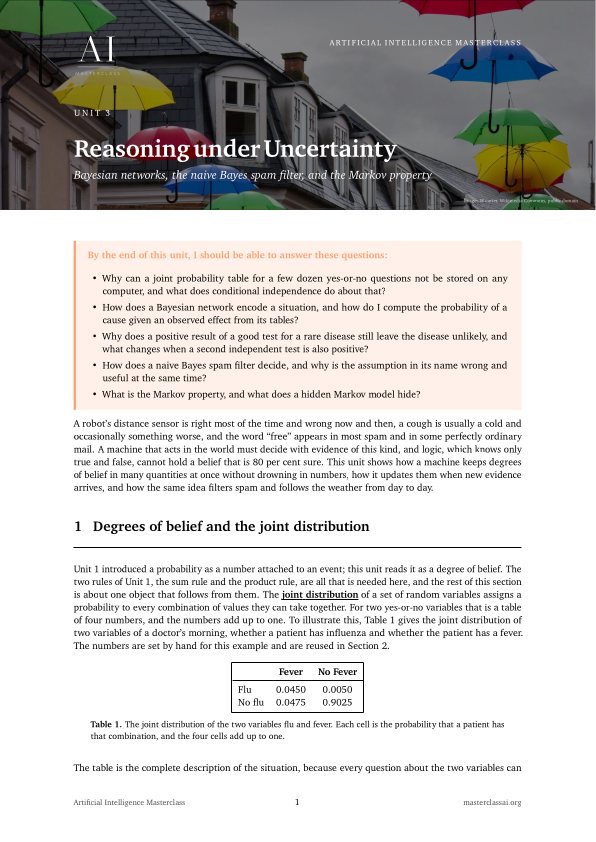
Unit 3, 16 pages Reasoning under Uncertainty

A machine that acts in the world must decide with evidence that is sometimes wrong. This unit shows how a joint probability distribution answers every question and why it is far too large to store, how a Bayesian network shrinks it with conditional independence, and how inference by enumeration and Bayes' theorem turn an observed effect into the probability of its cause. The naive Bayes spam filter and a Markov chain of the weather are worked through with every number, and a hidden Markov model infers rain from umbrellas.

Opening questions

  1. Why can a joint probability table for a few dozen yes-or-no questions not be stored on any computer, and what does conditional independence do about that?
  2. How does a Bayesian network encode a situation, and how do I compute the probability of a cause given an observed effect from its tables?
  3. Why does a positive result of a good test for a rare disease still leave the disease unlikely, and what changes when a second independent test is also positive?
  4. How does a naive Bayes spam filter decide, and why is the assumption in its name wrong and useful at the same time?
  5. What is the Markov property, and what does a hidden Markov model hide?
First page of Unit 3: Reasoning under Uncertainty
Learning from data, Units 4 and 6

A network of Unit 6, trained in this page

Two inputs, two hidden neurons, and one output, starting from random weights and trained by backpropagation on the four XOR examples. The shading is the network's output over the whole input plane, dark for 0 and bright for 1. Once it has learned, the bright regions cover the two corners where exactly one input is 1.

Epoch 0

Sigmoid neurons, cross-entropy loss, learning rate η = 0.5 with momentum 0.9. Training stops when the loss falls below 0.05. Some random starts end in a local minimum, and the page then says so.

Games

Games, Units 2 and 12

Black and white Go stones on a wooden board in warm light.
Go has about 2.1 × 10170 legal board positions. In March 2016 AlphaGo, which combines search with networks trained by reinforcement learning, beat Lee Sedol; its 37th move in the second game was one its own policy network estimated a human would play with a probability of about 1 in 10,000. Dietmar Rabich, CC BY-SA 4.0, source
A tall black IBM RS/6000 SP computer cabinet of Deep Blue on display in a museum.
One of the two cabinets of IBM's Deep Blue, which searched chess positions and beat world champion Garry Kasparov in May 1997. Erik Pitti, CC BY 2.0, source

Academic community

Masterclass participants come from all over the world, and when you complete the program you stay part of a network that keeps you close to AI research.

AI academics in our community
5000+
Countries represented
90+
Schools and universities represented
750+

AI-Connect

Our alumni program connects former participants across countries: for study advice, exchange about university applications, and shared projects.

Opportunities

Past participants hear from us about scholarships, competitions, summer schools, and other academic opportunities in artificial intelligence and machine learning.

A place in research

The program shows you how AI research is done and where it happens, so that your next step, at school, at university, or at work, is an informed one.

From the blog

What you can do with an AI degree

Seven jobs that a degree in artificial intelligence, computer science, mathematics, or statistics leads to, with the institutions behind them, the share of a week spent on data, code, mathematics, and writing, and the honest words about how many stay in research.

How to read an AI paper as a beginner

A machine learning paper is read in an order that is not the order it is printed in: the abstract, then the figures, then the main results table, then the ablations, and only then the method. The 2015 residual networks paper as the worked example, with the places where the caveats hide.

Does a language model know what it is talking about?

Train a small transformer on nothing but lists of moves from the board game Othello, with no picture of the board, and ask whether it holds the board in its head. A probe says yes; editing the board inside the network and watching the move change says it uses it.

Frequently asked questions

Who is this program for?

For high school students, university students, and lifelong learners. High school students use it to understand the systems they use every day, to get a head start before a degree in computer science, mathematics, or engineering, and to prepare for the AI olympiads. University students in computer science, mathematics, engineering, physics, economics, or any subject that now uses machine learning take it next to their degree, before a lecture course in machine learning, a thesis, or a first project. Lifelong learners, among them many programmers from other fields, teachers, and people who work with AI tools, use it to learn what is underneath. The Foundation masterclass suits a first contact with the subject; the Advanced masterclass goes on to convolutional networks, embeddings, transformers, and reinforcement learning.

What do I need to know before I start?

School mathematics is enough: powers, simple equations, functions and their graphs, basic probability, and the idea of a slope. Unit 1 teaches everything else the first masterclass uses, including vectors and the dot product, matrices, conditional probability and Bayes' rule, logarithms, derivatives, and the gradient, and each calculation is shown step by step. Later units add what they need with a short explanation. An integral appears only inside a box marked as a derivation, with every step explained in words; the main text never depends on it.

Do I need to know how to program?

No. No unit depends on code. Every method is worked by hand on data small enough for pencil and paper: four flowers, a 3 by 3 image, a sentence of three words, a 4 by 4 gridworld. The quizzes and the final exam test understanding without asking you to write a program. If you want to code, the tool of the week that comes with each unit is where that happens: a free notebook, a visualizer, a library, or a dataset, with two or three things to try. Participants who already program find that the units explain what their libraries do; participants who do not can follow everything without them.

How much time do I need each week, and are there live sessions?

Most participants spend three to five hours a week: two or three hours on the unit, under an hour on the open-book quiz, and the rest on the further reading or the tool of the week if they want them. The program is fully online and has no live sessions, so it works in every time zone and next to school, university, or work. You receive the units by email and read them on the website or as PDF. Quizzes and the final exam are taken on the website.

Can I finish the program in less than 12 weeks?

Yes. A new unit is scheduled for every Monday, but once you have submitted the quiz of a unit you can ask for the next one ahead of schedule, from your dashboard or from the email we send you. The earliest moment is 24 hours after the previous unit was sent. We recommend the weekly rhythm, because the material needs time to settle, but the pace is your decision.

What happens if I fall behind or have to pause?

Nothing is lost. The next unit is only sent once you have submitted the quiz of the current one, so the program waits for you. You can pause for a week or for a term and continue at any time. There is no penalty and no deadline.

Every word of this sentence gives its largest weight to "learning".